

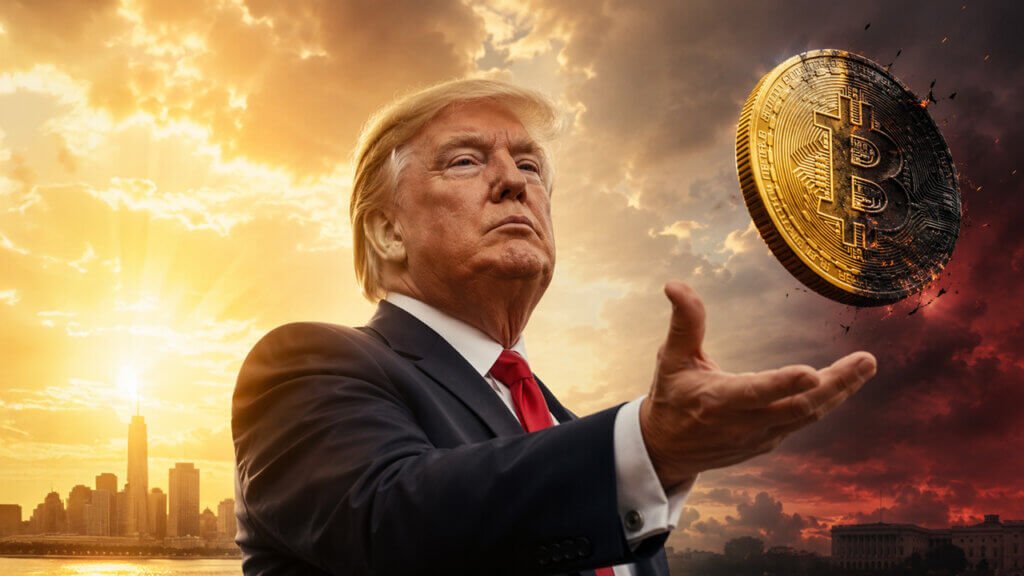
Bitcoin’s Trump question is more complicated than price
Donald Trump’s presidency has created one of the most difficult political questions in Bitcoin: has his administration helped BTC by pushing it closer to official US recognition, or has it damaged Bitcoin’s neutral image by turning it into a partisan asset? The answer is not simple because Bitcoin’s value depends on more than price. It depends on legal durability, institutional confidence, public trust, adoption, and whether people across political lines still see BTC as open money rather than a party-branded trade.
On one side, Trump’s administration has clearly moved Bitcoin deeper into the US policy conversation. The clearest example is the shift toward recognizing public blockchains, self-custody, mining, validation, and a Strategic Bitcoin Reserve as part of federal crypto policy discussions. That changed Bitcoin’s political ceiling because BTC was no longer being treated only as something to regulate, tax, or liquidate. It was being discussed as an asset the state could formally hold or protect. (CryptoSlate)
Why Trump has been positive for Bitcoin’s official status
The strongest argument in Trump’s favor is institutional recognition. For years, Bitcoin faced the risk that US policymakers could treat it mainly as a threat to financial control, banking compliance, or monetary policy. A friendlier White House posture reduces that fear. It gives asset managers, miners, ETF issuers, public companies, and long-term investors more confidence that Bitcoin will not easily be pushed outside the legal financial system.
This matters because markets do not only price current demand. They also price political risk. If investors believe the US government is less likely to attack Bitcoin mining, self-custody, or institutional BTC products, then Bitcoin becomes easier to hold. That does not guarantee a bull market, but it can reduce one of the biggest long-term fears around the asset. In that narrow sense, Trump’s presidency has been positive for Bitcoin.
The price record is not a clean victory
The problem is that price alone does not give Trump a simple win. Bitcoin can rise during a presidency for reasons that have little to do with the president. ETF demand, global liquidity, halving cycles, institutional adoption, inflation fears, and risk appetite can all drive BTC. A president can improve the political backdrop while Bitcoin still struggles because macro conditions turn against risk assets.
That is why the net-positive argument must stay limited. Trump’s Bitcoin record looks strongest when judged by political recognition and weaker when judged by price durability. Bitcoin may benefit from a friendlier administration, but it still has to survive bond-market pressure, dollar strength, ETF outflows, leverage resets, and global risk-off events. A supportive president cannot remove those forces.
The partisan divide is the real long-term risk
Bitcoin’s biggest problem under Trump is not that one political party supports it. The risk is that Bitcoin becomes identified too strongly with one side of US politics. Bitcoin was created to be neutral, borderless, and independent from governments. Its strongest appeal is that anyone can use it regardless of party, country, or ideology. If BTC becomes culturally framed as a Trump-aligned asset, it could lose part of that broader neutrality.
This matters because future administrations can reverse tone quickly. If Bitcoin becomes a partisan symbol, then a future anti-Trump or anti-Republican government may treat it more aggressively. That would make Bitcoin’s legal position less stable, not more stable. The best outcome for BTC is bipartisan acceptance, where both parties see it as financial infrastructure rather than a political weapon.
Trump-linked crypto ventures create reputation pressure
Another challenge is the reputation problem created by Trump-linked crypto businesses and political branding. Bitcoin itself is separate from any individual, company, or campaign, but public perception does not always make that distinction. When political figures promote crypto or become linked to crypto ventures, critics may use those connections to argue that the entire industry is driven by conflicts, insider access, or speculation.
That creates a difficult situation for Bitcoin supporters. They may welcome pro-Bitcoin policy while still worrying that political branding weakens Bitcoin’s credibility. The protocol remains neutral, but the public conversation around it can become messy. If ordinary households already associate crypto with scams, meme coins, exchange failures, or political influence, stronger White House support may not be enough to rebuild trust.
Adoption still has to prove itself
The strongest test for Bitcoin is not whether politicians mention it. The strongest test is whether people and institutions actually use and hold it in a durable way. On-chain activity has not delivered a simple grassroots adoption boom that can be credited directly to Trump’s policy shift. Some network signals have remained mixed, showing that official recognition does not automatically create everyday Bitcoin usage. (CryptoSlate)
This is important because Bitcoin’s long-term legitimacy must come from more than executive orders or campaign speeches. It needs sustained demand, stronger public understanding, better custody options, wider institutional access, and a legal framework that survives beyond one administration. If that happens, Trump’s presidency may be remembered as an important bridge. If not, it may be remembered as a period that made Bitcoin more political without making it more trusted.
A limited net positive, but not a complete win
The most balanced answer is that Trump’s presidency has been a net positive for Bitcoin in a narrow institutional sense. It has raised BTC’s status in Washington, reduced some fears of federal hostility, and made Bitcoin harder to dismiss as a fringe asset. That is meaningful.
But the partisan risk is also real. If Bitcoin becomes too closely tied to Trump, it could lose the neutrality that made it powerful in the first place. Bitcoin’s best future is not as a Republican asset or a Democratic asset. Its best future is as neutral money that governments, institutions, and individuals cannot easily politicize.
FAQs
Has Trump been good for Bitcoin?
Trump has been good for Bitcoin in terms of political recognition and institutional confidence. However, the broader impact is mixed because price action, public trust, and adoption remain harder to measure.
Why does political support matter for Bitcoin?
Political support matters because it can reduce regulatory fear and make institutions more comfortable holding or building around Bitcoin. A friendlier policy environment can improve confidence.
Can Trump’s support hurt Bitcoin?
Yes, it can hurt Bitcoin if BTC becomes too strongly associated with one political party or leader. Bitcoin’s long-term strength depends on neutrality and broad acceptance across political lines.
What would prove Bitcoin benefited long term?
The strongest proof would be durable laws, transparent reserve policy, sustained ETF and institutional demand, stronger public trust, and real adoption that continues beyond one presidency.
